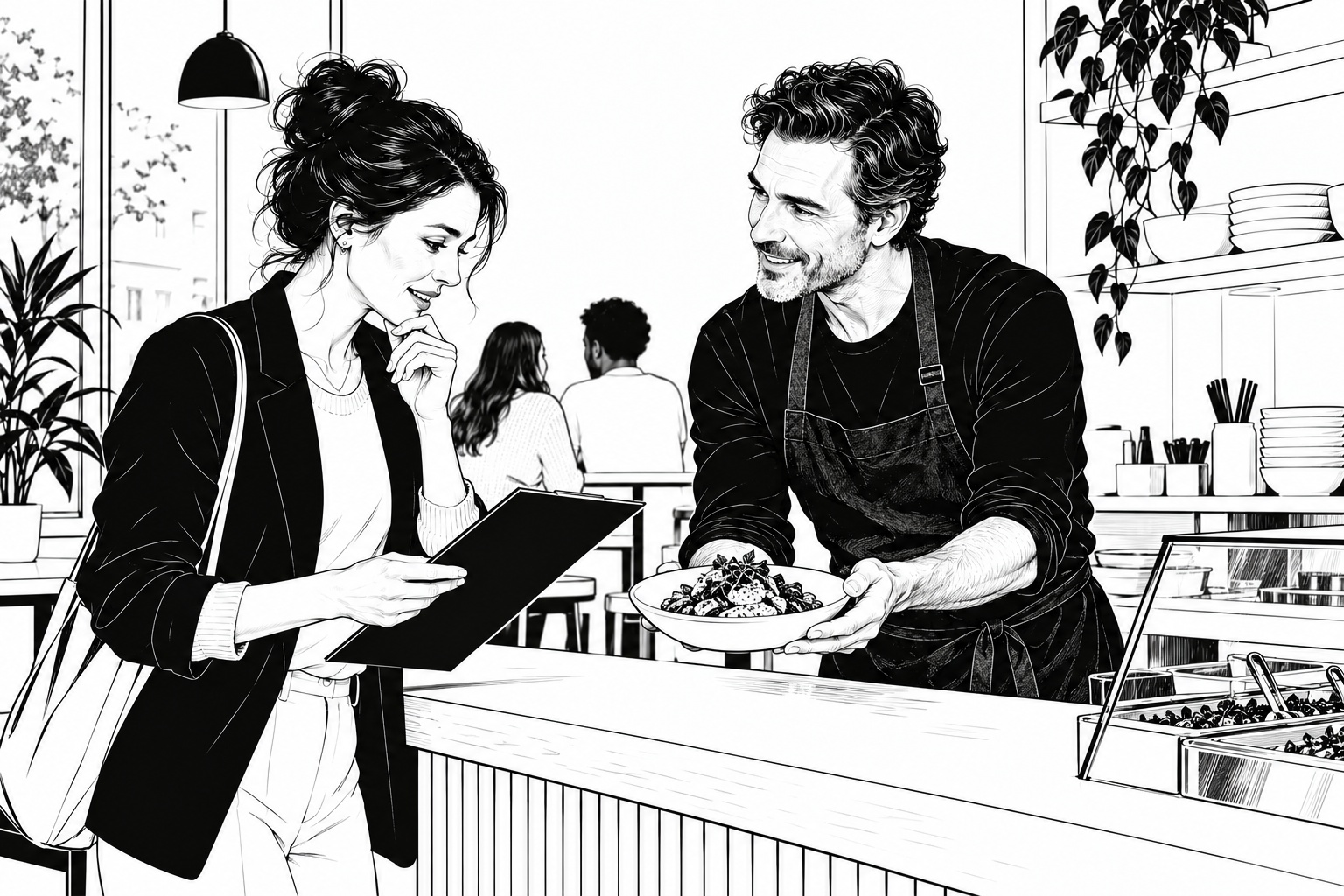
Somewhere in the American market you’re considering, a customer is deciding what to eat again.
Same lunch problem. Same family takeout debate. Same coffee stop. Same question after work: what are we picking up tonight?
For an international food brand, that ordinary decision is the opportunity.
You don’t need every American to love your food. You need enough nearby customers to choose it often enough, at the right price, with the right cost structure, to support a profitable location.
That’s a much more useful goal than “conquering America.”
If you’ve built a strong food concept in your country, give yourself credit. Customers already choose you. Your team knows the product. You may have franchisees or operators who understand the rhythm of the business.
But the American customer hasn’t lived that history with you.
They need a simple reason to try you, and then a better reason to come back.
The spending habit exists. The National Restaurant Association’s July 2026 update forecast 4.3 percent growth in restaurant and foodservice sales for the year, below its earlier 4.8 percent expectation but still showing a very large market where people already buy prepared food.
That doesn’t promise traffic for your brand.
It does mean you aren’t trying to invent the habit of eating out or ordering in.
Convenience matters too. The Association’s 2025 off-premises research found that many adults buy takeout or use drive-thru regularly, and separate Association research described off-premises dining as a major share of restaurant traffic.
So the question becomes practical.
Where does your food fit into an ordinary American week?
Is it lunch? Dinner? A family order? A workday snack? A weekend treat? A catering item? Something people pick up on the way home?
The answer may be different from your home market.
That doesn’t mean you abandon the identity of the food. It means you adapt the way customers buy it.
A savory bakery may sell mostly individual items to commuters at home. In a suburban American market, family packs, advance ordering, or workplace delivery may matter more. The food can stay recognizable while the purchase occasion changes.
America’s cultural variety makes this interesting, but it also makes lazy assumptions dangerous.
Some customers may know your cuisine well. Some may know a related version. Some may be trying it for the first time. Familiar customers can tell you whether the product feels authentic. New customers can show you which descriptions make the offer approachable.
Neither group is one group.
Age, income, household routine, personal taste, and neighborhood alternatives all matter.
A good launch respects that complexity without watering down the concept until it loses the reason people cared in the first place.
Competition shouldn’t discourage you. It should educate you.
Established chains know how to hire, buy, market, and operate in the U.S. Independent restaurants often understand the neighborhood better than anyone. Their presence tells you customers already spend money on meals outside the home.
Your job is to show a specific difference that matters enough for a customer to change a habit.
That difference may be product quality, convenience, freshness, a signature item, a better family order, or simply a more dependable version of something people already want.
Start narrower than your ego wants to.
A focused menu is often easier to teach, easier to buy for, easier to market, and easier for a customer to understand. A long menu can look impressive on paper and create waste, training problems, and inconsistent execution.
The first American location should teach you what customers actually repeat.
Not what they praise at the opening.
What they buy again.
Takeout needs its own test. Food that tastes excellent beside the kitchen may suffer after 20 minutes in a container. Packaging, travel time, portion design, and reheating all matter. A beautiful product photo is worth much less than a satisfied customer eating at home and ordering again next week.
The economics deserve the same honesty.
Food cost, labor, delivery fees, rent, packaging, waste, and local marketing all affect whether the model works. A profitable recipe at home becomes a credible U.S. franchise only after it earns money under American conditions.
That’s the positive case for testing carefully.
If the first market works, you aren’t guessing anymore. You know which products repeat, which customers respond, what staff must learn, which supplier issues matter, and what a franchisee would actually be buying.
The most encouraging sign isn’t a line on opening day.
It’s the ordinary customer who comes back without a discount, without an event, and without needing to be convinced all over again.
Enough customers like that can build a serious American business.
Sources
National Restaurant Association, July 2026 Industry Outlook Update
https://restaurant.org/research-and-media/research/restaurant-economic-insights/analysis-commentary/restaurants-remain-resilient-despite-challenging-business-conditions/
National Restaurant Association, 2025 Off-Premises Restaurant Trends
https://www.restaurant.org/research-and-media/research/research-reports/off-premises-restaurant-trends-2025/
National Restaurant Association, Off-Premises Dining Research Release
https://restaurant.org/research-and-media/media/press-releases/from-trend-to-transformation-off-premises-dining-now-essential-for-restaurant-consumers%2C-operators/